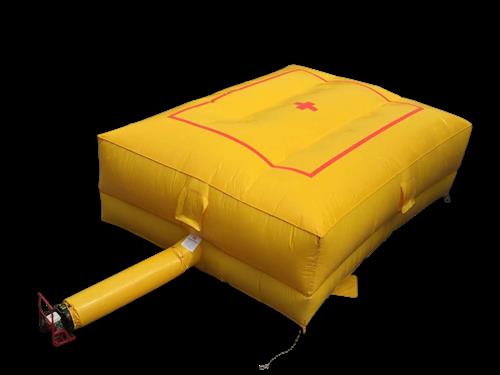
Rescue air cushions for high-rise building escape are mainly divided into two types: air column-type rescue air cushions and blower-inflated (standard) rescue air cushions. They differ in structure, working principles, application scenarios, and advantages.
1. Air Column‑Type Rescue Air Cushion
Working principle: Uses a high-pressure air cylinder (e.g., aluminum‑inner‑lined full‑wound composite cylinder) to rapidly inflate independent air columns inside the cushion. After inflation, the air columns support the entire cushion structure.
Key advantages:
Fast inflation: Usually completes inflation within 30 s, with some models needing only about 28.76 s, enabling quick response.
No continuous power supply required: Once inflated, the air columns maintain pressure independently without relying on a running blower, suitable for environments with limited or no power supply.
Easy to transport: The whole set weighs about 92.5–95.4 kg and can be carried by 2–4 people, allowing flexible deployment.
High stability: The air‑column structure provides stronger support and better impact resistance, making it suitable for frequent or high‑intensity rescue operations.
2. Blower‑Inflated Rescue Air Cushion (Standard Type)
Working principle: A high‑speed blower is connected to an intake hose to continuously inflate the whole cushion. The blower must run throughout use to maintain pressure.
Key advantages:
More uniform cushioning effect: The entire cushion is a soft structure that can dynamically adjust pressure through vent windows, absorbing and dispersing impact more gently.
Lower cost: The structure is relatively simple, and manufacturing/maintenance costs are generally lower than for air‑column types.
Wide applicability: Widely used in fire‑drill exercises, suicide‑rescue scenarios, etc., with mature and reliable technology.
High adjustability: The blower can supply air in real time, adapting to different body weights or consecutive jumps, making it suitable for multi‑person training sessions.